Tuesday, 24 July 2007

Dialogue about End of Oil, Coal and CO2 emissions


... sudden resurfacing from summer hiatus...

An imaginary conversation:

Person A: C2 output (pollution) and oil consumption go hand in hand, right?

Person B: Mostly. Coal is worse than oil in this regard. You could roughly simplify the situation like this:

[Coal + oil + natural gas use] + [rainforest cutting/biomass loss] = CO2 rise

Person A: Serious problems (besides the current war for oil in Iraq and possible war in Iran) will probably become evident after 5 years to many. This based on signals in the mass media like FT, WSJ, etc.

Person B: Possible. I'd give a range of 1-7 years, maybe more, before oil shortage starts to hurt OECD countries a lot.

If one says that current oil futures price is due to only oil shortage of below ground factors (i.e. geological depletion), then shortages are already starting to hurt via price increase and resulting creeping inflation.

However, before OECD countries are hit badly, poor countries will be priced out of the market (happening for the past year and a half). Also developing countries will hit energy shortages (starting to happen at the time of writing this, in Latin America, Asia and even Eurasia).

As always with future, exact timing or effects are impossible to predict. Things could go really bad late next year, if the Kingdom of Saudi Arabia is dry and they can't raise their production, Venezuela production keeps falling and Russia does not recover.

Addition. Venezuela just informed last week (3.8.2007) that in 2008 there will be very little if any oil for export.

Person A: By the time oil product have become expensive and hard to get CO2 output will diminish. So, there is a good side to this all. No oil=less CO2.

Person B: Unlikely. We will use coal instead. Also, we may use the fastest ramping liquid fuel alternatives (i.e. food cereals to bio-fuels), which can be worse in CO2 emissions with current practices than petroleum oil (this depends on farming/logistic practices).


But why coal?
  • More abundant than oil (cheap)
  • We know how to produce energy out of it (easy, fast, scales)
  • Competitive to make Coal-to-Liquids (oil alternatives, although not in great scale)
  • China's building 500 new coal plants (no carbon sequestration)
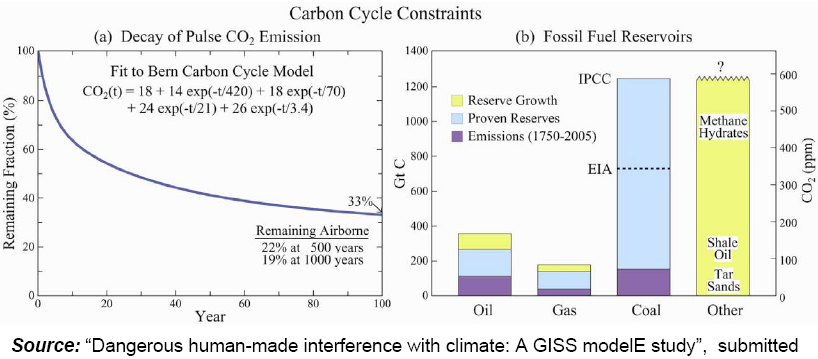
Coals is much worse bigger CO2 emitter compared to petroleum oil (coal to electricity, no CCS).
Even if we capture CO2, Coal-to-Liquids will produce 4-8% more CO2 than burning the same amount of oil.

There is absolutely no hope of reducing CO2 emissions by burning out oil quickly, because economic growth requires energy and coal is the next available, easiest and most logical choice according to cornucopia economists.

Unless economy crashes (depression, not a mere recession). Then consumption will go down and so will energy consumption and thus, CO2 emissions.

As James Hansen of NASA/IPCC has said it (paraphrasing):
We can burn all remaining oil and still theoretically solve the climate crisis, but if we start burning the remaining coal, we have absolutely no hope left.
Person A: If the "oil use=>co2 emissions" link is true, why not focus on using a lot of oil now really fast? The faster it is gone, the faster CO2 emissions go down?

Person B: As outlined above, increasing oil consumption is not sane for the CO2 emission reasons, although not necessarily catastrophic by it itself.

However, there are other reasons for using it fast (if not indiscriminately) now:
  • It's available now, use it wisely now that you can afford it (build something sustainable)
  • The faster we run out, the more we go cold turkey and have to radically change our way of life
Person A: Point is, how about this on a bigger scale? Can this be turned into a
a climate survival strategy or even a consumption trend? Can we burn ourselves out of the problem by making ourselves short on energy and then having to cut down on consumption radically?

Person B: Some really advocate this. Even system modelers that build world energy/CO2 models say that less people will die if we burn all remaining oil quickly, than if we burn them slowly, find alternatives in the mean time and keep growing like lemmings.

But it's just a model. Nobody knows. Maybe we all just dance into la-la-la-land on a road made of rose petals while singing Hallelujah. You're guess is as good as mine.

... back to summer, they're too short to miss...

Tuesday, 10 July 2007

The cat is out of the bag...


Financial Times reports that "World will face oil crunch in five years", basing this on the latest IEA Medium Term Market Report for Oil (July 2007). The even more conservative WSJ puts a slightly different spin on it: "IEA forecast underlines oil, gas supply worries".

However, even IEA's somewhat unexpected lack of faith is seen as too optimistic by some, esp. in regards to KSA ability to ramp up it's own production of oil.

So there you have it.

Demand will outstrip production c. 2010. That is 2,5 years away. Let the ramifications of that sink in for a while.

Shortages not later than 2012 according to IEA.

Beyond that. It's anybody's guess, but unless Iraq and others ramp up as hoped, after 2015 it'll be very, very hard to sustain production - not to mention actually meeting growing demand.

As to whatever all this means, it's up to you to decice. However, it is not - just another transition. Biofuels are expected to provide 1.75 million barrels / day in 2012, which is less than 2% of world total oil demand.

I repeat the old mantra: economize (esp. get out of debt), localize (esp. in regards to work, family and sustenance) and produce (esp. something of actual physical daily value).

Thursday, 5 July 2007

What Energy Crisis?


"There is plenty of oil for everybody, no shortages exist."


"High oil price is not a problem."


"Having temporary tight oil supply is not a problem."


"We can always drill more!"


"There is plent of natural gas. That'll help us."


"There is plenty of electricity to go around. Let's go electric!"


"There is no energy crisis. Rising demand will be met by rising production."


"Go back to sleep. Everything is fine. No need to do anything."

Sunday, 1 July 2007

Videos on Peak Oil

Yes, understanding Peak oil can be difficult. Statistics after statistics, decision trees to prune, probability functions to consider and depletion functions to model.

A plain old video hit piece does the job of hammering the message in so much more effectively, even if some corners are cut.

Energy Standard team has probably seen most of the available documentaries and video pamphlets about peak oil. The quality varies immensely, but there are some really useful ones out there.

Below is a collection of some peak oil videos worth watching. Some easier, some shorter, some longer. Take your pick.

Interview with M. King Hubbert, 1976, 2 mins.

Description: The father of Hubbert's Peak of oil production, M King Hubbert explaining to us what the peak is. His 70's estimate for peak of crude oil was 1995-2005, depending on how OPEC adjusts their production. Crude oil production did peak in May 2005 and we are now running on fumes (condensates).


End of the Oil Age, BBC, 2005, 40 mins.

Description: A roundtable interview presented by Paul Mason (BBC). Interesting comments from James Howard Kunstler, Paul Ormerod (economist) & Felipe Fernandez Armesto (historian).

Criticism: Economists in the interview fall into the "let's create more energy through technology" trap. One should be aware of the laws of physics and remember that energy cannot be created out of nothing. In addition, it is useful to consider that it took us c. 100 years to create our oil, coal and natural gas based energy & urban infrastructure. It cannot be replaced in ten or twenty years by anything. Hydrogen or not, one must abide to laws of physics.


End of the 1st Half of the Oil Age, Fuelling the Future Conference, 2006, 33 mins.

Comments: Colin J Campbell walks you through how oil is formed, what are the physical limits to production, why more investments can't solve production issues and what it means when the world hits peak oil production.

Criticism: Quality is a bit off, it may be difficult to understand all the implications at times, unless you follow closely and know some backround data. Regardless, half an hour well spent.

Interview with Matthew R Simmons, Bloomberg TV, 2007, 5 mins.


Matt Simmons of Bloomberg on Peak Oil

Comments: "We are at Peak Oil now". Where we could be now according to Simmons.


Robert Newman's History of Oil, 2006

Comments: Robert Newman's biting stand up comedy about Peak Oil, war in Iraq, house of Saud and so much more. It's a laugh, even if you don't buy into any of the Peak Oil arguments.

Criticism: Should be painfully obvious and not a criticism as such, but do not use this as an accurate reference on history.

Other documents available online:


Do note, that these people are respected authorities in their fields. I do not often call for authority, but consider the fact that these people have put their names and reputations on the line, to say something, which many still don't believe is true. Pluse they have the facts on their side. That tends to help.

If you want something to watch on the telly, then the following docs available on DVD:


The End of Suburbia, (trailer)


Crude Impact
, (trailer)


A Crude Awakening: The Oil Crash, (trailer)


Crude - The Incredible Journey of Oil, (view online)

Friday, 29 June 2007

Quotes of the day


"What it comes down to: the North plans to steal food from the South to feed the North's cars, lawn mowers, ATVs, jetskis, snowmobiles, speedboats, gokarts etc. the various euphemisms of "comparative advantage" and the definition of food, soil and water as fungible commodities dispersed in the corrosive solution of transnational money camouflage this bottomline reality: a car eats more than a human being."

- Deanander, from EuroTribune, recommended reading [emphasis added]


"A lot of governments, especially in Europe, the United States, and Japan, are encouraging use of agricultural fuels. Some of these policies are not founded in solid economic rationality : biofuels will continue to be very expensive to produce. But even if these policies were carried through with, we think the share of biofuels in world fuel production in 2030 will only be 7%. To reach those 7%, it will be necessary to use a farmland surface equivalent to the combined total areas of Australia, Japan, Korea, and New Zealand combined..."

- Dr Fatih Birol, IEA chief economist, in an interview with Le Monde (6/2007, emphasis added)


Thursday, 28 June 2007

Food vs. Fuel war brewing


Many people and institutions have warned about the coming fight between biofuels and food for arable land.

Even the mainstream media in Europe and USA have been hammering the message in lately: first generation biofuels from edible crops is brain dead idea. Further, even non-food biofuel crops may compete with food crops for the same acreage.


When biofuels compete with food production, what happens?

At this point the astute reader has understood the underlying reason why the price of food and energy has been cleaned from the most common inflation index, even though those represent a major inelastic part of everyday consumption.

When you combine this with the fact that per capita global food production has already hit a peak and is at is currently lowest in 50 years, there is a possibility of a big political storm brewing.

Again, the poorest nations will take a hit first: when oil is too expensive and critical for infrastructure (incl. electricity production) and price of bio-fuel crops go up, then edible crops are abandoned for more lucrative crops.

Fortunately, some developing nations have already understood the precarious balance between food and fuels. China's ban on use of corn for biofuel could be a sign of things to come elsewhere.

However, the ever inventive market is now showing signs of turning to other sources, like fruit. This does not solve the problem, merely shifts it around.

Food into fuel drives up the world prices of most major food crops, making it increasingly more difficult for poor nations to solve the edible crop shortage through costlier imports.


So, what happens? People starve. Nothing new there.

And in the end, we accept it, because it calms the markets and lets us think we can compensate for the plateauing crude oil production with biofuels, which in turn enables us to keep running our economies, planes and cars.

So, we keep on producing unsustainable biofuel types, even if it reduces edible crops on the market and drives up the food prices.


However, if the situation gets dire enough, through an added shock to the system, like a massive serious of world wide droughts for example, then even biofuels could become too expensive for us, while food prices remain high.

What drives this apparently risky development?

Sane or not, the advance of biofuels is driven by various forces:
  1. Our relentless and growing consumption of oil
  2. Urgent need for greenhouse gas emission reduction
  3. Strong lobbying for subsidies and associated (American) political alignment
  4. Increased insecurity about energy (read:oil) security: not enough production is local
  5. Growing nervousness about supply of oil refinery products
  6. Still expanding green tech & biofuel business boom
So, it looks like biofuels we will get and food less so.

Will this tension between fuel and food production result in a crisis or local political instability as predicted?

Let's look at what the magic 8-ball says:


Ah well, till the next time

Wednesday, 20 June 2007

Intermission


Thursday, 14 June 2007

PO Summary - Got the Lingo?


Trying to understand energy crisis related discussions can be daunting: abbreviations, technical concepts and lots of background data is often assumed to be understood by each participant.

Let's look at an example.

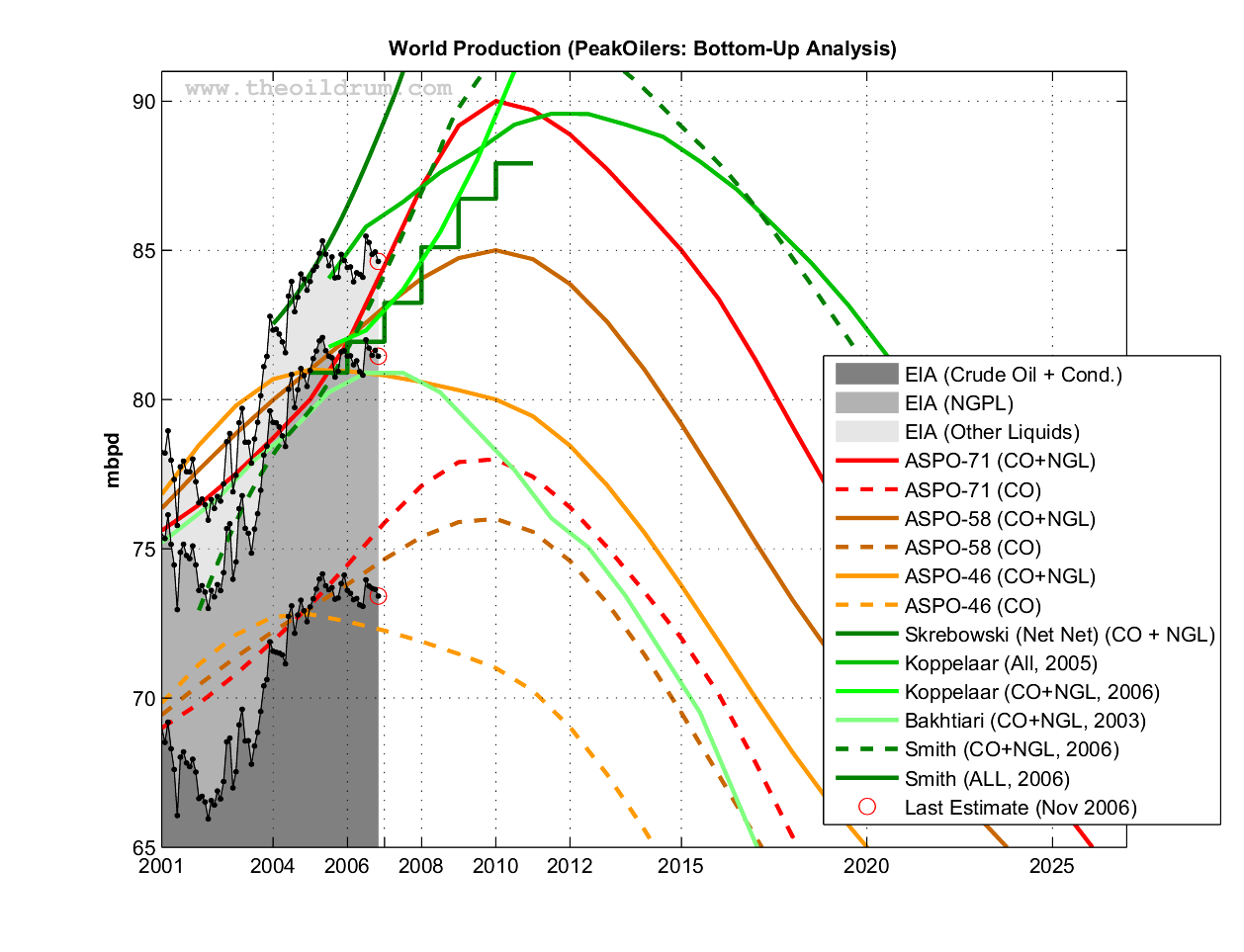
Many people believe in PO, due to multiple modeling techniques showing a Hubbert Peak within the next 10-13 years for total liquids in the world. Yes, there has even been peer-reviewed scientific papers on the subject.
In plain English: We can't grow our daily oil production rate indefinitely. Daily oil production rate will likely peak before the year 2020. When production peaks, demand will exceed supply. Many engineers and scientist have studied this. A lot of them agree on the time of peaking.
Now, why is that a problem? According to the Hirsch Report, the minimum mitigation time before peak is 20 years. It is highly probable we have less time available than that. According to most grim estimates, only one fourth of that. There are oil industry insiders and energy bankers who have claimed we may be at peak now. Supply-demand gap is incredibly thin, cushions are gone. Demand has already exceeded supply in poorer areas.
Plain English: Changing cars, trucks, planes, boats and generators to run on electricity takes 20 years or more. Demand for oil may greatly exceed oil supply well before that. Many experts say we can't increase our daily oil production anymore. This means we are at production peak now. Some countries are already experiencing oil shortages. In Africa, oil shortages are happening today.
What would we do, if we had 20 years? Many say "biofuels".
A lot of scientists are increasingly weary of bio-fuels, due to EROEI being proven very low and sustainability of fuels being in doubt (mp3). Also, there's a significant scaling challenge as well in production of bio-fuels.
Bio-fuels may take more energy to make than what they give. Making bio-fuels will not help us supplant fossil oil. Also, bio-fuels may not cut greenhouse gases. Further, bio-fuels may not be available in as huge volumes as we use fossil oil.
CTL and GTL fuels have their own scaling issues and the GHG impact is considerable. Also, there's that nasty issue of overall hydrocarbon resource depletion.

So, even if successful, alt-fuels will only provide a small wedge, not a replacement for fossil oil.

That means, PO is mostly a liquid fuel crisis.
We can only make a bit of oil from coal or gas. This will not be sufficient to cover our oil demand. Also, coal and gas based alternative fuels cause additional greenhouse gas emissions. Further, the amount of natural gas and coal reserves we have left is uncertain. We will need lots of different new liquid fuels to replace diminishing oil. We face a shortage of liquid fuels. A crisis of energy in liquid form.
Now, what is a likely scenario in this crisis?
Short term, one must factor in two important issues, on physical, another economical:
  1. Falling net energy of oil production, due to diminishing API and increasing sulfur ratio, not to mention increased discovery, drilling and pumping energy costs. This results in a compound upward price pressure on top of the normal resource shortage.
  2. ELM. Available exports fall faster than production. This may result in shortages and certainly raises the prices even further.
The rest of the oil we have left is of increasingly worse quality. It takes more energy to pump it out of ground. It takes even more energy to make it usable diesel and gasoline. Rising energy costs will raise the price of remaining oil, even if demand stayed steady. However, demand is rising, not staying steady, so it also adds to rising energy prices.

Export Land Model (ELM) studies how much oil is exported. Majority of oil production in the world is in the hands of less than a dozen producers. With most of them, their domestic oil consumption is growing faster than their oil production. When their oil production starts to peak, they will need more of the oil for domestic production. As a result, producers will export less oil. This exported oil is what dictates the price of oil on the world market. It also dictates whether people in oil consuming countries have oil to use at all. If producers do not export, consumers cannot buy. Whatever the price.
What could these issues lead to? Nobody knows, but several obvious causalities have been suggested by various authors:
A lot of things are already taking place and it is likely that the trends will intensify for the foreseeable future.
Some argue that as oil demand greatly exceeds supply: countries will go to war for oil. More food will be turned into bio-fuels. This will result in food shortages in poorer countries. Oil dependent African and Asian countries will experience electricity blackouts. Purchase of oil will be rationed. Oil may unexpectedly run out for a while. Natural gas, coal and electricity will be used more to help with oil shortage. Prices of coal, gas and electricity will rise. Countries will start to build more nuclear power plants. Not enough nuclear power plant makers exist to make plants for all who want them. Price of uranium will continue to rise.
Of course, there would be ways to solve supply-demand gap.

Let's first look at the options that are unlikely to work other than as minor temporal mitigation wedges:
Technology breakthroughs do not create energy out of nothing. When oil starts to run out, more energy is needed. Available energies include nuclear, wind, solar, tide and geo-thermal. These can supplant some of the needed oil. However, there is no single technological fix or alternative source will make the problem go away quickly. Transition to alternative energy sources will take time. Some of the alternatives are likely to fail (e.g. 1st and 2nd generation biofuels). Some alternatives are just too expensive in terms of price (2nd and 3rd generation biofuels). Some just do not make any physical sense (e.g. hydrogen production via electrolysis).

Energy efficiency increases are useful in the short run. On the long run efficiency savings are lost in increased energy use. It is difficult to conserve oneself out of the liquid fuel crisis problem. At least, it is impossible to do it without harming economic growth and current global trade.
Other, more systemic solutions have been proposed, such as CJP's Oil Depletion Protocol also known as the Rimini Protocol, which is these days promoted by RH, who also advocated powerdown.

However, due to the pessimistic mode of many of PO thinkers (doomers), ODP is not seen as a very realistic option.
Oil depletion protocol states makes countries to reduce their oil consumption at the same rate that world oil production diminishes. Protocol requires that the countries sign and abide by it. Currently no large oil using country has written the Oil depletion protocol. Many believe that nation states are more likely to price bid or go to war for oil. States are unlikely to voluntarily reduce their consumption. Doomer is a person who thinks that the current economic status quo and wellbeing of the world is not sustainable. A doomer thinks that oil production peak will result in a doom of the civilization. In the diminished version, doomer thinks that oil peak a radically restructures the world society.
Many, in fact (yours truly excluded) believe in some sort of a cataclysmic overshoot collapse, like forecast by th Olduvai Theory. Some even believe the thermo/gene collision is the inescapable future of mankind.
Some people Peak oil will result in the collapse of the known civilization. Arguments are based on exceeding the carrying capacity of earth. Only stored energy (such as oil) has enabled humans to exceed carrying capacity temporarily. When that energy is used up (non-renewable), carrying capacity limits will be met.
But let's take a deep breath. No need to skip peak oil stages.

Don't paralyze yourself. Nobody has a crystal ball. Forecasters have been wrong before. No need for doomer-porn.
Malthus was already wrong over a hundred years ago. Or at least he was off with his timing, because he didn't factor in hydrocarbon resources, such as oil, coal and natural gas. Those postponed the peak at least a hundred years. People who love to think pessimistically about peak oil, will often indulge in scenarios of dystopia. Consuming such scenarios in large doses may not be healthy for one's mental state.
So, what is there to do?

ELP, is one option. Permaculture another. Relocalization a third one.
Economize, Localize and Produce. Make do with what you really need. Start acting and consuming locally to conserve energy. Become less dependent on things from afar, whether food, services or work. Start producing things basic things that are needed and valuable. Permaculture guides one in sustainable living. Relocalization is an effort to start up and develop local community actions.

Oh, why are techno-fixes unlikely to work? In the old tradition of Finnish math books, the proof is left as an exercise for the reader.

Tuesday, 15 May 2007

Is algae bio-diesel (also) a fool's gold?


Everybody loves to hate 1st generation biofuels these days. Inefficient, polluting, do not scale well and net energy losers. In short: totally useless waste of money and energy in terms of energy production. Very useful for political gains though.

Now, some people are more optimistic about 2nd generation biofuels, esp. cellulosic ethanol and similar processes from plant based feed. However, serious doubts have been cast on their sustainability as well (economic, ecological and net energy wise).

The greatest hope has been given to algal biodiesel. It has been touted as the fastest growing (scaling), least energy input and best fuel output biofuel type. It was supposed to become an explosive growth area and solve our biofuel scaling problems.

Up until now.

Two posts, referencing some of the most realistic studies in the field, cast a really big shadow over algal biodiesel.

A direct quotes from Dr. Krassen Dimitrov's paper:

"Fundamental thermodynamic constrains make it impossible for such approach to be commercially viable for fuel prices below $800/bbl, even if flawless technological implementation is assumed." (emphasis added)

"A PBR-based biodiesel plant will have a maximum carbon mitigation potential of less than 30 kgCO2/m2/yr" (read: miniscule, emphasis)

"Biofuel production in PBR-based plants compares unfavourably with other alternative technologies for liquid fuel production, carbon mitigation and solar energy." (emphasis added)
This is not to say that biofuels from algae are not currently among our best bad hopes for biofuels replacing fossil fuels. It's still the best scaling and apparently best net energy ratio biofuel out there. Both currently and in theoretical improvements. (If somebody is thinking CTL, yes it's a probability for non-biofuel alternatives, but the ghg emissions are not pretty compared even to gasoline).

Algal bio-diesel is just not enough.

Nothing known scales to 85 million barrels of use per day. Not even 1/10 of that. It is just not physically possible to grow that amount of biofuel. The land area, energy inputs and logistics do not make sense. Thus, the economic does not make sense either.

Still, algal biofuels will be made, will be improved and I'm betting there'll be an investment bubble around them, just as there's one now around bio-ethanol (1st gen), which is more or less complete bogus.

If you are an investor, you have been warned: don't try to break physics with an investment plan.

Friday, 11 May 2007

Oil & Energy in the world - a month or so in review

Just another month? Perhaps, perhaps not.

A lot of interesting things have happened in the previous month.

Of course, this is all old new to those who have been following any of the usual suspect sites during the past months. The picture is unfolding almost like the overall script dictates: shortages, deniel, more peaks, price rises, speculation, asset bubbles & resource grabbing.

Now the information is being legitimized and published in wider circulation. More people will read it. More people will start writing blogs, discussing and piecing information together. More news on the issue. Definitely papers and politicizing on the issue.
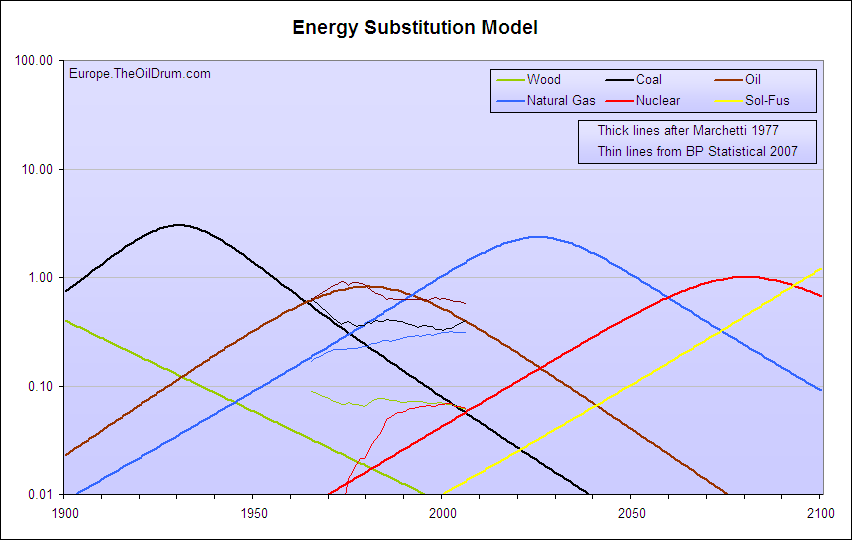
Out of all the noise of news, a picture is starting to emerge. Let's try an exercise, one of many optional pictures:
  1. The energy market as a whole has overheated, following the similar trends on various asset markets. Biofuel markets are slowly merging with food markets, with important consequences
  2. Oil demand growth is still too strong, supply is limited and near future is even more uncertain. Prices are likely to rise, even without supply disruptions (Nigeria, Iraq, etc.) and natural disasters (hurricanes hitting refineries)
  3. Future of worldwide supplies compared to demand is starting to come under serious doubt. Nobody has publicly shown numbers to convince the numbers people that production can scale to projected need.
  4. Future energy replacements for oil (nuclear, biofuels, coal, syn-crude, natgas) are looking less optimistic (scaling, sustainability, energy, carbon offsets). This includes the most optimistic of current biofuels: algae based bio-diesel. The rest, including corn ethanol, is mostly an expensive smokescreen.
  5. The positive feedbacks in the system are getting easier to spot: prices spiraling up -> dash for deep water oil resources -> shortage of equipment and people in oil services sector -> more investments in alternatives -> more hyping of alternatives & new (small) oil discoveries -> more clouding of the fundamentals of flow rates, reserve replenishment and demand growth
  6. Global Warming still reigns supreme as the topmost important topic of our time, but the connection between the two is still rarely made. Everybody seems to assume coal ihas to be gone, but the amount of commissioned plants being built is increasing, not decreasing.
  7. People, politicians and markets are becoming more nervous about the energy issues, especially the price, but still seem to believe that delivery is guaranteed.
If one combines the slow realisation of the above factors (true or not, with timing uncertainty) with the current economic situation, the combined picture doesn't look overly optimistic.

Are we heading for global energy demand destruction via a combination of price increases and slower economic growth?

Right now, with the data available, it sure does look like it.