Saturday, 22 October 2011

Nate Hagens on Oil, Bond Market, Stocks and Economy on going forward

Conventional oil peaked in 2005. All liquids from ground are on a +/-5% plateau. Each extra barrel required for economic real growth costs more. This squeezes the real world economy. This is the lesson of net energy return falling.


Solution?

Globally -- long and slow crash, via economic turmoil.

Communally : know your family, your neighbours and the locals. Pull together.

Personally: scale down, get better psychologically, physically, financially and spiritually.

Increase your resilience to shocks and outages.

Stay safe.

Friday, 29 April 2011

Why Economics is Wrong

An excellent 20 minute talk from William Rees at the Institute of New Economic Thinking conference on how Economics is completely wrong modelling human ecological production.


If you don't understand it, watch it twice. It's really that important.

And if you're an economist and refuse to believe it, pick up some of the following for your reading list.

A Safe Operating Space for Humanity (Nature, 2009)
Towards a Green Economy: Pathways to Sustainable Development (UNEP, 2011)

Oh, why is this on an energy blog? Because economy drives energy usage and energy resources are a crucial part of our ecology. It's all connected. Thinking within the constraints of old academic domains will not lead to one really understanding the big picture.

Friday, 1 April 2011

Wesley Clark : We have a plan to take over Arab and African Oil Countries (since 2001)

Non-violent civil uprising in Egypt is already failing as the US jackals have taken over along with the Egypt military. This is merely a geostrategic move as Egypt is not important for it's oil reserves (it's a net importer).

However, the same cannot be said of Libya, Lebanon, Syria, Iran, Iraq, Afghanistan and Somalia.


"The Truth is about the Middle-East - had there been no oil there, it would be like Africa. Nobody is threatening to intervene in Africa." 
- Wesley Clark (retired general of US Army)

Nothing new here, this was already leaked in 2002, but a good reminder of what the playbook was and is. 

Thursday, 31 March 2011

Naomi Klein : Gambling with Risk with No Exit Strategy


Cost-benefit analysis works, until it stops working. After that, it offers no consolation, no idea of risk, no idea of backup, no idea of how to recover.

And as Nassim Taleb has so eloquently put, modern risk analysis is not just wrong, it's stupid.


Wednesday, 23 March 2011

Fossil Fuels in 338 Seconds

Do you want a really quick introduction to fossil fuels, energy use, economics, ecological issues and global warming?

Here it is - 200 years of past and guesses about the next 100 years:


Well worth watching.

Monday, 14 March 2011

A Comedic Diversion

Watch it before it's taken down by the copyright police:


If it's not up anymore, try looking for the Real Time with Bill Maher show from March 11, 2011 (episode 205).

4 and a half minutes well spent.

Saturday, 12 March 2011

Peak Oil Politics - Why Important Decisions Are Not Made

The following video excerpt from the 2007 Oil shock simulation is a good reminder of why important peak oil related conservation, energy infrastructure, military or energy transition decisions are not made, even though the issues are understood fairly well:

Oil Shockwave documentary segment

In the end, it all boils down to political popularity, policy realism and geo-political military issues.

Keep the oil flowing, at all costs.

Thus, do not expect US to start solving the peak oil issue any time soon - at least not without a crippling crisis first.

Perhaps the second oil price spike will do it. Or the third. Or the fourth...

Thursday, 10 March 2011

Oil production Spare Capacity in 1 slide

Steve Kopits

Since the revolutionary spirit started spreading to Libya, markets have been very nervous about oil.

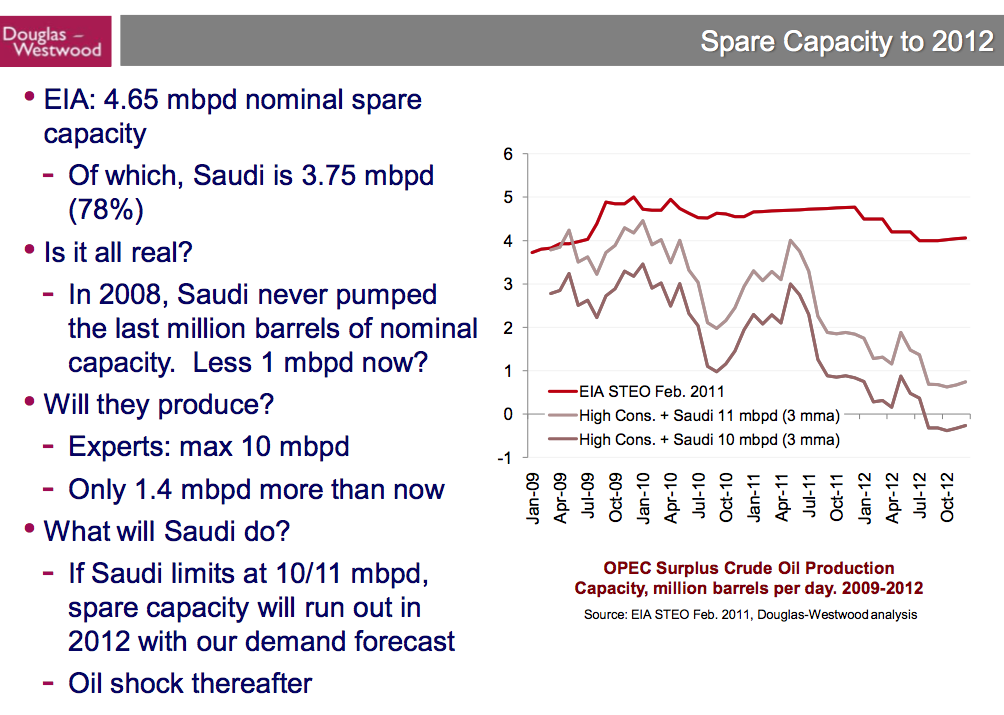
The official line has been that there's c. 5 million barrels of spare capacity within OPEC, so even if the whole of Libya production went offline, it would not cause a crisis.

And from that the discussion has exploded to all directions mainly from people who do not have an inkling of an idea what the supply/demand issue is.

So, Steve Kopits (Douglas-Westwood consulting) to the rescue. He sums up the situation in this one slide of his recent 'Oil, The Economy, and Policy' presentation:


So, there you have it. Oil shock by end of 2012 or shortly thereafter. Even if Libya and the rest of the Arab nations keep producing with very little hiccups.

John Fullerton : World too reliant on fossil fuels, local productions brings resiliency

John Fullerton (The Capital Institute), formerly from JP Morgan, now understands that infinite growth is impossible in a finite world. He now talks about resilient (lower efficiency) systems, local production, fossil fuel free local production and avoiding ecological crisis.

Here's Mr. Fullerton talking about these issue in a short 4 minute interview clip courtesy of Institute of New Economic Thinking.


So yes, even brain-washed bankers can get it. They just need to let go of dogma and look at science. The truth prevails in the end, even though it might take a bit of time.

One can watch the rest of the interview pieces on Youtube.

Monday, 7 March 2011

If Middle East goes, so goes the world...

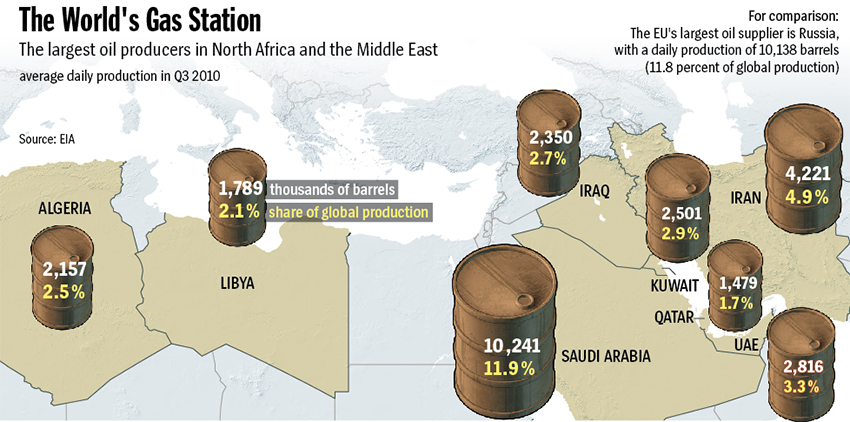
From Spiegel:


The OPEC spare capacity is officially 4.X Mb/day, but that is unlikely to be true and the crude qualities within OPEC are not all directly interchangeable for the European refiners.

A combination of any two countries from the above map is enough to wipe out the whole spare capacity.

Even if oil is in a parabolic trading move right now and likely to come down for a while, it doesn't meant the the problem will be over.

Until the unrest in ME starts to cool down, the prices will be fluctuating a lot.

Traders market, you have been warned.