Monday, 19 August 2013

SciAm on Energy Return on Energy Invested

The April 2013 issue of Scientific American had a decent interview with and overview of Charles A.S. Hall and his notion of Energy Return on Energy Invested (EROI).


A starter is to study and understand these two images:


And:


The latter is from recent presentation on Energy Capital Cost Requirements by Michael Dale from ASPO conference 2013.

Bentley & Zittel on Limits to Global Energy Flows

At the recent ASPO 2013 conference, Roger Bentley and Werner Zittel gave a joint presentation on the limits to global energy flows mainly from oil, gas and coal.


Their findings are nothing new to those who have followed the PO debate for the past years, but bare repeating:


  • Global conventional oil peak is now (will continue for some years)
  • Global natural gas peak in c. 10-15 years
  • Global (hard) coal peak perhaps within a few years
  • Alternatives have much lower energy densities and returns
  • Prices will keep going up, may go down in the short term (due to economic hiccups)
  • Move to alternatives will put a stress in form of a  growth slowdown to the economy
  • Official & Industry sources (IEA, EIA, BP, OPEC) have been systematically wrong in their oil production estimates
  • We have plenty of reserves under ground, but we can't get to them fast
  • If we consume everything, we will create a lot of environmental risks & damage
And oh yes, official policy is still mostly in denial about all this in most countries. Apparently people believed the fracking fairy tales and the future of 1:1 substitution of oil with natural gas (over night). 

Ah well.


Monday, 12 August 2013

The Economist admits it - We are at Peak

Yes, we are at conventional oil peak. Even the venerable The Economist admits in its August 2013 issue.


Of course, they can't do mea culpa, so they hide it as "peak demand", not peak production flows.

However, demand follows pricing, economic growth and policy decisions - and those are driven by basic oil field geology, not technology, not fanciful thinking or fairy tales about magical substitution.

At the time of writing this oil price (WTI) is at $106, at the time when the whole world economy is grinding to a halt again. Basic law of supply and demand -- if one believes in plentiful shale oil silliness -- would dictate a rapidly falling oil price. But this is not happening. The supply/demand margin is too tight. Supply is constrained, flow is at near peak - on an undulating plateau of maximum production. Unconventional liquids can only help this very modestly.

So, here we are - in 2013 and conventional oil production peak is starting to show it's effect. It will only get gradually more tight from here forward, with slight swings to the better and worse in the short term. The overall trend will be:

 - aggregate conventional production going down
 - prices going up
 - more swings in short term prices
 - more complaints about effects to world economy
 - more frantic investment in shale oil and tight gas (with mostly slow gains that fizzle out fast)
 - more instability in the Middle-East, more coups, more uprisings, more changes in power
 - more tensions between USA, Russia and China - all of which are gunning to get to the alpha dog position in the control of remaining conventional oil reserves (mostly in Middle East and in Africa)
 - more investment in natural gas and coal

Of course, this could all be wrong. We could just wake up, decide on a crash course to set things right, embark on worldwide coordinated conservations efforts and a plan to move off conventional oil dependency over the next 15-25 years or so. At the moment, the prospects for this kind of mass migration do not look good, but who knows - the future has a way of surprising us.

Here's to now. The only moment that matters. Use it wisely.


Friday, 19 April 2013

What came/comes out of the Shale/Tight gas/oil Miracle/Mirage?

A lot of hot air has been blown into the bubble called shale oil (often actually tight oil) miracle. The basic argument has been that soon the US will surpass that of Saudi Arabia as oil produces (and perhaps even exporter) due to non-conventional oil reserves and "advances in oil recovery technology".
Well, most of that is of course pure poppycock. Bakken and other US tight oil / shale formations are estimated to peak at around 2017:


The fracking miracle whis has greated the natural gas boom in United States is real, but with devastating environmental costs and unsustainable resource base. That is, it destroys groundwater resources, pollutes land and uses up more land these days in the active states than is used for wheat or corn production.

Further, unconventional resources always peak faster and once peaked, will decline extremely rapidly year-by-year, much faster than the old conventional resource bases that we got used to. This will create a frantic and increasing rate of drilling - a marathon to the death in order to just basically stand still (i.e. to stay even at the current level of production, not to say meet growing demand). That is not a miracle nor is it a future anybody in the fossil fuel industry hopes for. It's a race to the bottom.

Good resources on this issue is a fairly recent write up by Randy Udall titled 'The shale phenomenon: fabulous miracle with a fatal flaw' (2013), the Tullett Prebon report 'The Perfect Storm' (2012) and Chris Nelder's recent post on Smart Planet blog (2013).

Robert Hirsch - Nexus of Energy & Risk in the 21st Century

Presentation by Dr. Robert Hirsch on Peak oil and likely consequences from November 2012.

Some teasers:


There you have it. Nothing's changed. We are still on plateau. Price is still on an oscillating at-least-linear (more likely exponential) tendlike rise, which is triggering increasing recession-central bank intervention periods.

Tuesday, 7 August 2012

Reminder: The New Energy-Economic-EROEI Reality

The brilliant ecologist Charles A.S. Hall gave an ASPO-Webinar recently about 'Peak Oil, Declining EROI and the New Energy-Economic Reaility'. The simplified version of Hall's argument should be easy to understand:

Wealth creation (and it's proxy GDP) is based on energy resources


The growth rate of even wealthiest nations is declining:
Oil is becoming thin on the ground:

Due to increased drilling the EROI of oil production is going down:

This also increases oil prices:

Thus a larger chunk of money AND energy is going into energy production:
....leaving less money & energy for the rest of the economy:

This creates a new world, where the old economic models and policies do not work:


That's it. What else do you need to know? How will you react. This is an ongoing process. You are in it. You can make a choice as to how you will adapt to the new world. It starts with an attitude and education.

If you want to see the whole presentation along with Hall's voice, you can watch the Webinar on Vimeo or if you want the analytical version, you should read Hall's book 'Energy and the Wealth of Nations'.


Wednesday, 16 November 2011

Kyle Bass on European Debt Restructuring

The most important point of this video comes between 5:15 and 6:00.


The more important point from the point of energy is this:


There is NO way that oil production can grow at the speed required by the world credit market interest rate payments to be covered by real (non-financial) economic growth.

As Jim Puplava put it: Brent oil barrel price is the new global and automatically rising federal funds rate. It will cut off all economic growth every time it goes above $120-$140 / barrel (in c. 2008 dollars, as you have to keep  inflation in mind).

The world economy is toast. There is no way around it.

No amount of extra credit can solve this.

Only debt restructuring (i.e. default) will solve the economic issue.

The limited flow rate of energy guarantees that no other options is available.

And the more this issue is pushed into the future with temporary emergency measures, the bigger the debt that has to be written down will be and the faster the oil flow rate decline will be (it's increasing day by day).

And thus, harder the landing.

Brace yourself for impact in this slow-motion train wreck and try to position yourself to the last cart on the train.

Thursday, 10 November 2011

Peak Oil, ERoEI, Maximum Power Principle & Markets

Excellent 13 minute Q&A with Nate Hagens, who understands the way we use oil, the coming supply crunch and how financial markets work.


For a more detailed discussion of some of the concepts discussed, check the the presentation A Framework for Supply and Demand on a Full Planet (35 mins).

Saturday, 22 October 2011

Nate Hagens on Oil, Bond Market, Stocks and Economy on going forward

Conventional oil peaked in 2005. All liquids from ground are on a +/-5% plateau. Each extra barrel required for economic real growth costs more. This squeezes the real world economy. This is the lesson of net energy return falling.


Solution?

Globally -- long and slow crash, via economic turmoil.

Communally : know your family, your neighbours and the locals. Pull together.

Personally: scale down, get better psychologically, physically, financially and spiritually.

Increase your resilience to shocks and outages.

Stay safe.

Friday, 29 April 2011

Why Economics is Wrong

An excellent 20 minute talk from William Rees at the Institute of New Economic Thinking conference on how Economics is completely wrong modelling human ecological production.


If you don't understand it, watch it twice. It's really that important.

And if you're an economist and refuse to believe it, pick up some of the following for your reading list.

A Safe Operating Space for Humanity (Nature, 2009)
Towards a Green Economy: Pathways to Sustainable Development (UNEP, 2011)

Oh, why is this on an energy blog? Because economy drives energy usage and energy resources are a crucial part of our ecology. It's all connected. Thinking within the constraints of old academic domains will not lead to one really understanding the big picture.

Friday, 1 April 2011

Wesley Clark : We have a plan to take over Arab and African Oil Countries (since 2001)

Non-violent civil uprising in Egypt is already failing as the US jackals have taken over along with the Egypt military. This is merely a geostrategic move as Egypt is not important for it's oil reserves (it's a net importer).

However, the same cannot be said of Libya, Lebanon, Syria, Iran, Iraq, Afghanistan and Somalia.


"The Truth is about the Middle-East - had there been no oil there, it would be like Africa. Nobody is threatening to intervene in Africa." 
- Wesley Clark (retired general of US Army)

Nothing new here, this was already leaked in 2002, but a good reminder of what the playbook was and is. 

Thursday, 31 March 2011

Naomi Klein : Gambling with Risk with No Exit Strategy


Cost-benefit analysis works, until it stops working. After that, it offers no consolation, no idea of risk, no idea of backup, no idea of how to recover.

And as Nassim Taleb has so eloquently put, modern risk analysis is not just wrong, it's stupid.


Wednesday, 23 March 2011

Fossil Fuels in 338 Seconds

Do you want a really quick introduction to fossil fuels, energy use, economics, ecological issues and global warming?

Here it is - 200 years of past and guesses about the next 100 years:


Well worth watching.

Monday, 14 March 2011

A Comedic Diversion

Watch it before it's taken down by the copyright police:


If it's not up anymore, try looking for the Real Time with Bill Maher show from March 11, 2011 (episode 205).

4 and a half minutes well spent.

Saturday, 12 March 2011

Peak Oil Politics - Why Important Decisions Are Not Made

The following video excerpt from the 2007 Oil shock simulation is a good reminder of why important peak oil related conservation, energy infrastructure, military or energy transition decisions are not made, even though the issues are understood fairly well:

Oil Shockwave documentary segment

In the end, it all boils down to political popularity, policy realism and geo-political military issues.

Keep the oil flowing, at all costs.

Thus, do not expect US to start solving the peak oil issue any time soon - at least not without a crippling crisis first.

Perhaps the second oil price spike will do it. Or the third. Or the fourth...

Thursday, 10 March 2011

Oil production Spare Capacity in 1 slide

Steve Kopits

Since the revolutionary spirit started spreading to Libya, markets have been very nervous about oil.

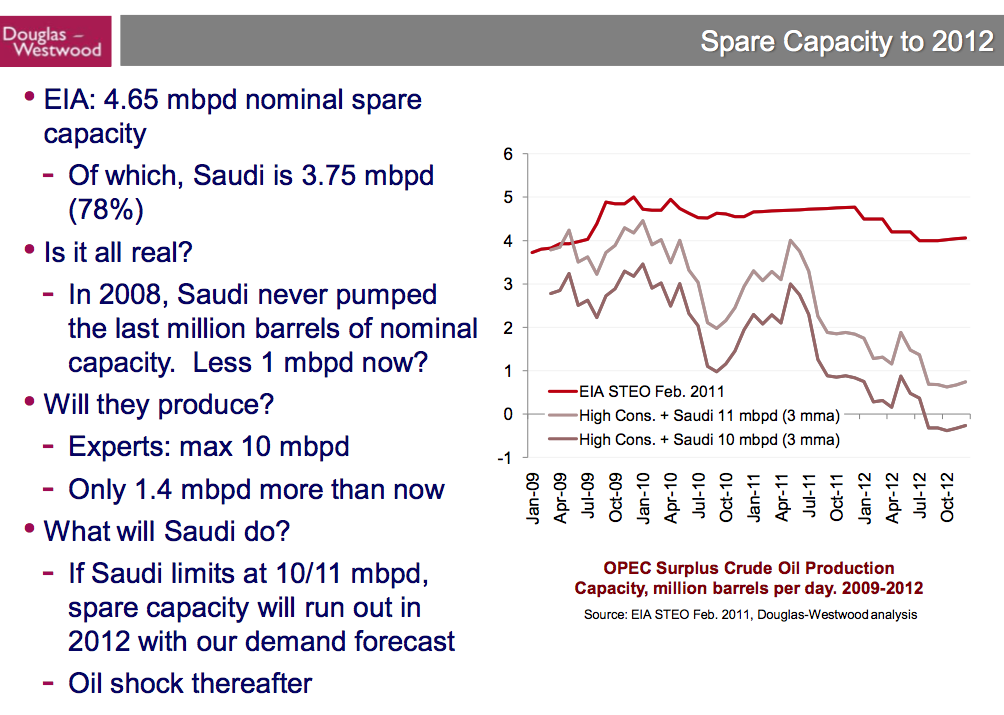
The official line has been that there's c. 5 million barrels of spare capacity within OPEC, so even if the whole of Libya production went offline, it would not cause a crisis.

And from that the discussion has exploded to all directions mainly from people who do not have an inkling of an idea what the supply/demand issue is.

So, Steve Kopits (Douglas-Westwood consulting) to the rescue. He sums up the situation in this one slide of his recent 'Oil, The Economy, and Policy' presentation:


So, there you have it. Oil shock by end of 2012 or shortly thereafter. Even if Libya and the rest of the Arab nations keep producing with very little hiccups.

John Fullerton : World too reliant on fossil fuels, local productions brings resiliency

John Fullerton (The Capital Institute), formerly from JP Morgan, now understands that infinite growth is impossible in a finite world. He now talks about resilient (lower efficiency) systems, local production, fossil fuel free local production and avoiding ecological crisis.

Here's Mr. Fullerton talking about these issue in a short 4 minute interview clip courtesy of Institute of New Economic Thinking.


So yes, even brain-washed bankers can get it. They just need to let go of dogma and look at science. The truth prevails in the end, even though it might take a bit of time.

One can watch the rest of the interview pieces on Youtube.

Monday, 7 March 2011

If Middle East goes, so goes the world...

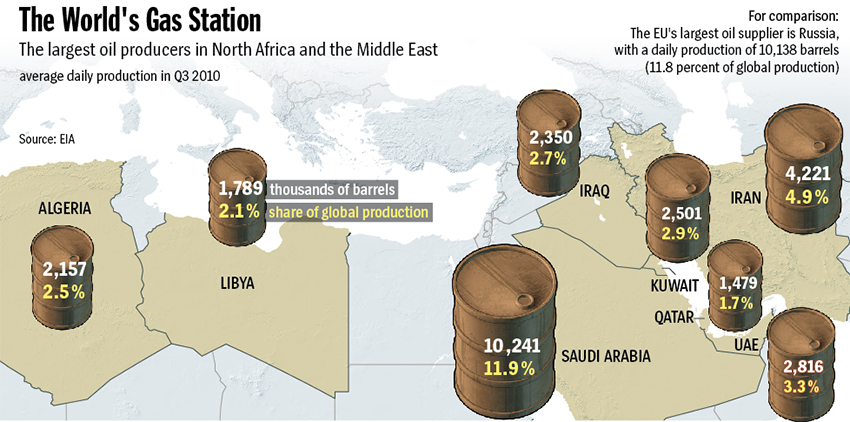
From Spiegel:


The OPEC spare capacity is officially 4.X Mb/day, but that is unlikely to be true and the crude qualities within OPEC are not all directly interchangeable for the European refiners.

A combination of any two countries from the above map is enough to wipe out the whole spare capacity.

Even if oil is in a parabolic trading move right now and likely to come down for a while, it doesn't meant the the problem will be over.

Until the unrest in ME starts to cool down, the prices will be fluctuating a lot.

Traders market, you have been warned.

Sunday, 6 March 2011

MyWorld 2050 - GIGO in action


The UK Propaganda Department of Energy and Climate change has released their energy policy toy, called MyWorld 2050.

The idea is to let people play around with energy supply, like fossil fuels, nuclear and alternatives, and then match this with the demand coming from industry, housing, heating, transport and travel.

The goal: get to 80% CO2 reductions by 2050.

You can try the model yourself at the MyWorld 2050 web site.

Now, some issues that the model behind the game doesn't lay bare:

  • There is extremely low probability that oil will flow at 50% of current levels in 2050. There just are not enough resources, drill holes, tankers and manpower.
  • Not using fossil oil creates a liquid fuel problem, which the model suggests one fix with biofuels. The problem is that the model assumes we can burn the rest of the developing world's (who have all the money, btw) food for fuel. And the model further assumes this will reduce CO2 emissions and be net energy positive. The premises behind that logic are faulty.
  • Clean coal and gas power are supposed to give a 15 point CO2 cut. Eh, where exactly do we have clean coal? And oh, the North Sea gas is mostly in decline by 2025 (remember the model is originally for UK).
  • Hydrogen cell powered cars. Sigh, that's like selling second order financial derivatives on a lollipop you have already eaten. Most sane thinkers thought we we past that already.
What the system does underline, is that it is impossible to not to have a liquid fuels problem, unless one goes all out on biofuels overseas in developing nations. What the system doesn't tell is that there is no arable land left to do this, unless we take it from food production or burn down the rainforests.

And all this is done with extremely low demand scenario, where people will be living in 16C temperature homes and travelling very little privately, doing mostly car sharing and public transport.

Good luck selling that scenario to the ignorant masses at large.

The more technically minded can download the 2050 Pathways Excel spreadsheet (Office 2010 format, thank you DECC idiots) that reveals some of the thinking behind the model.


Sunday, 27 February 2011

Why The Economist doesn't understand energy

The following image is from The Economist which argues that the use of energy is being reduced as measured by Energy intensity of the economy (percentage of GDP).


An astute reader of energy physics and economics should understand the obvious failings of the above diagram for any argument about energy intensity of economies:


  1. The graph measures energy use per GDP unit, whilst including all of the financial GDP. However, financial GDP is pure speculative money, consuming very little energy, but also contributing very little to society. Further, using USA as a proxy for most OECD countries, financialization of the economy has been growing steadily for several decades now. It should be cleaned from the GDP to get a more meaningful measure of 'energy use per unit of GDP in the real productive economy'.
  2. The energy consumption is based on figures from BP, which does not account for grey energy imports. Grey energy imports have been rising for all OECD and lately even for developing countries. They can account for up to 25% to 30% of total energy consumption. If not included, the figures can be seriously skewed, especially for developed industrial countries within the OECD.
  3. The correction to GDP figures (PPI 2009 level) has probably been done using CPI figures. We know from energy consumption figures, growth of monetary aggregates  and statistical corrections done in the CPI calculations (i.e. hedonistics) that these figures are unreliable: they are likely to understate the inflation, thus overstating economic growth in real terms.


However, the most obvious and glaring misuse of the following graph to argument in favour of energy not being a problem for economic growth is thinking that GDP growth solves energy consumption growth. Make no mistake, absolute energy consumption is and has been going up (the only exception years being those of deep recessions). The energy consumption growth has just been relatively slower than the skewed GDP figures The Economist used above.

After all these minor statistical quibbles, the main problem is not the relative scarcity of energy sources to economic growth, but absolute consumption growth and absolute limits. Anybody with a half an hour's worth of reading in ecological economics should understand this immediately.

If energy consumption per capita as a % of GDP was the only problem, then we could avoid the rolling energy crisis by nationalizing everything and raising hourly wages for everyone by controlling prices. This would show up as increased GDP, near zero inflation and the amount of relative energy consumption to GDP would to go down.

That’s the theory anyway, if one is stupid enough to believe the misleading propaganda from The Economist.

Think for yourself. There is no substitute for it.