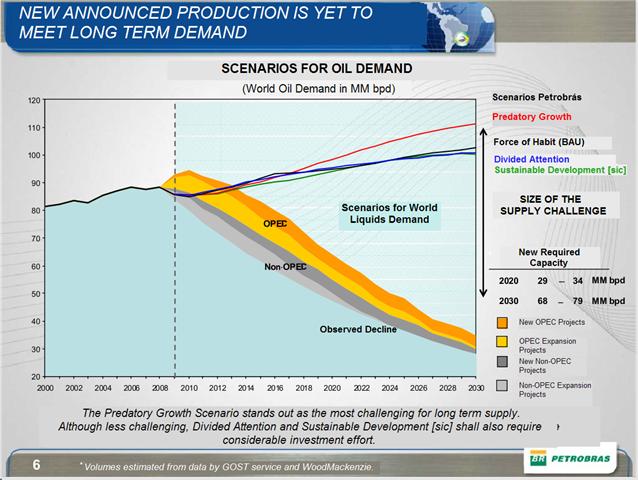
Ah, those magnificent Brazilian sub-salt oil finds that heralded the end of peak oil. Never mind the fact that they would at best postpone the global oil peak roughly 90 days or so.
Well, now the Brazilian oil company Petrobras' CEO, Lucio Pementel, is throwing more fuel to the fire by saying the world oil production will peak this year (via TheOilDrum).
Due to reduced demand from the Great Financial Crisis v1.0 (v. 2.0 coming soon to an economy near you), the supply-demand crunch should not hit us until 2013 or 2014 in their projects.
So again, that pesky 4 years of extra breathing room is there. At best. If we are lucky.
... because two economists have calculated that the demand has not peaked and that demand projections by the big three (i.e. IEA, EIA and OPEC) are underestimated by roughly a third.
biofuels cannot fill the gap - not enough land for food and biofuel production
unconventional oil is way too CO2 intensive - need an alternative
not enough investments into alternative liquid fuels
In a related interview the founding director of Smith School, Sir David King, warns (again) about shortages and oil price spikes in coming years.
The question is not any longer whether the cat is out of the bag, but for how long can the mainstream politicians control the information and keep the masses calm.
Never mind, keep the music playing! Economy is recovering, unemployment is decreasing, house prices are bouncing, car sales are booming and oil consumption is....
Jeremy Rifkin: The Empathic Civilization (50 mins)
"The entire economic engine of the industrial revolution turned off at 147 USD a barrel.
Our fossil fuel energies are sunsetting.
The entire infrastructure of this civilization is embedded in the carbon deposits of the Jurassic age. Our agricultural food is grown in petrochemical fertilizers and pesticides. Almost all of our pharmaceutical products are still fossil-fuel based. Most of our clothes... The entire construction infrastructure of civilization is fossil-fuel-based. Our power, transport, our heat, our light, our logistics, our supply chain. What we are seeing is the sun-setting of these energies and the life support of the infrastructure built from them.
That's what we haven't yet come to grips with." - Jeremy Rifkin
A new paper titled 'Forecasting World Crude Oil Production Using Multicyclic Hubbert Model' in the journal Energy & Fuels by Ibrahim Sami Nashawi, Adel Malallah and Mohammed Al-Bisharah of Kuwait University and Kuwait Oil company shows a new analysis of World oil peak production for conventional oil. Their estimate for peak of conventional oil is 2014. Their implied world production decline rate is somewhere in the vicinity of 2.6% p.a.
World Oil production peak and cumulative estimates
Conventional is important, as it accounts for roughly 80% of the world's oil production. No known alternative, whether unconventional, biofuels or natural gas liquids can fill the gap left behind by conventional oil depletion.
Four years to peak is also significant, as we know from previous studies that a proper precautionary crash course mitigation program for peak oil would take roughly 20 years. That is, 20 years before the peak, which is now forecast to be within four years by the Kuwaiti researchers.
"Forecasting is not accomplished by consulting a crystal ball or a mystic of some sort, but by appraising the past, inspecting present conditions, and projecting these into the future based on the best available information."
Their decline rate, while optimistic by historical accounts, is a sigh of semi-relief. If true, it'd mean a much less of a downslope of production loss than imagined by many other authors. This would give the world more time to adjust in an ordered manner. However, based on the decline rates of real fields in the world, driven by the best technology, their estimate of seems fairly optimistic. If the true decline rate is three times as high as it seems likely, it remains very unlikely that any society, except the oil exporting nations within yet-to-peak faction of OPEC have any time to structurally adjust to the change.
Why is this information still not on the front page of every newspaper on earth? Because it is bad news, it's abstract, it can always be denied due to commercial/geo-political reasons, and people just do not understand the ramifications of oil peak.
For people writing about oil depletion finding supportive research can always feel rather schizophrenic. One one hand it is easy to feel vindicated about years of work of trying to get others to understand. On the other hand it is evident that people still do not get it and would rather just stick their head in the sand. This implies that on the average we all deserve what's coming to us.
Yet, four years is a long time. One can still do a lot of things personally in that time, even though it is very unlikely to change the big picture for all of us. It can also whizz by in an instant, depending on the choices one makes.
If you knew for sure that you had roughly four years before the slow decay really starts to kick in and turn a lot of good things into mush, then the only relevant question remaining is this:
8:30 - good for a cup of tea and some brain teasing
"How can Societies expect [growth] when we face [oil decline]... and what policies do we have in order to be peaceful and equitable... It's possible if we prepare, but if we deny the problem then we will never manage.
This should be a last wake up call to even those who don't get the fact that energy will be our multi-decade challenge - peak oil or no peak oil. We need energy miracles to combat the challenges of population growth, poverty reduction, CO2 emissions and dirty energy:
He also reminds us that the combined total battery capacity of the whole world (including your ipods and cell phones + those batteries inside all Priuses) would hold:
10 minutes. Even if we'd get an order of 10 times improvement in batteries (100 minutes) and replaced them all, it still isn't enough. We need an order of 100-200 preferably. That's a tall order, ask any battery researchers.
Then Mr Gates moves onto nuclear power - not the usual type reactors, but what he calls a travelling wave reactor.
Nothing too ground-breaking about it - it's a variation of the old breeder ideas: burn all the fuel, not just the first 1% of it. We should really have had these 60 years ago, but better late than never. It's mostly an engineering challenge to get it working, no fundamental physics issues involved.
He also breaks down the population growth, economic growth (service demand), energy efficiency (energy/service unit) and greenhouse gas emission reduction efficiency (emissions/energy unit) into a useful simple high level equation:
Watch the whole video to get a better idea.
What Gates did not mention, and I'm sure he gets, but is too tough cookie to throw at the over-optimistic TED crowd is this.
Electricity counts for c. 14% of total world energy demand. The rest is pretty much all fossil fuels and wood burning.
Of that 86% of rest, almost third is liquid fuels, which is what the world runs on. The world runs on trade. The trade runs on wheels, ships, trains and planes. And they almost exclusively run on oil.
Now, the real equation that Gates should be looking at is this:
Total Energy utility = EROEI x Scaling Factor x 1/Price x 1/Infra x Emissions/Joule x ROI/time x availability/geography x Liquid Fuel Replace Factor x 1/Ecosystem depletion
Whatever energy systems we build, it needs to give out more energy than what it consumers - and do it rapidly. Unlike most nuclear plants that start returning net energy after 10+ years (starting from construction).
It also needs to be able to be scaled to a Exajoule scale. Biofuels, tar sands need not apply. It also cannot be a flux or a flow, because there just isn't enough storage capacity.
It needs to be relatively cheap to invest, require very little new infrastructure to build and emit very little emissions per joule generated over total lifecycle (including all the new infra, investments, etc).
Then it needs to generate economic payback rapidly, much more than new oil fields, or tar sands, or wind. It needs to beat all those, to take over the minds of energy investors. Remember, investors do not care if the investment destroys the environment or if it's an EROI loser - all they care is about Return On Investments. So any newcomer must beat oldtimers on that equation as well.
On top of this, it needs to be widely and generally available all over the world: in rich countries and in poor countries - south and north - east and west. Otherwise, esp. if it's fuel based - it'll just be the new spice to replace the old spice and wars will be fought over it. Wars are mostly net energy losers, huge greenhouse gas emitters and certainly do not reduce overall poverty.
Then last, but not least, it needs to be able to replace liquid fuels - without speeding up the ecosystem depletion and reducing the carrying capacity. Now, that is a really tough challenge. In this test, all current biofuels in production fail and so do unconventionals. Electricity is not liquid. The infrastructure change needs are huge.
Any way one looks at this equation, the challenge is not easy. And Bill's travelling reactors don't solve even 1/4th of the equation.
Yet, all engineering challenges are hard initially - and very systemic - sometimes wicked. Regardless of these, they do get solved, even if only in part.
Sometimes in part is better than nothing. The ideas presented in the video are certainly more worthwhile than building old dumb-style reactors.
Here's hoping the equation (or it's variation) gets solved and in time - as the challenge on the other side is reduction and potential powerdown. And that, would be a real challenge for poverty reduction and the current population levels.
"Get ready for a new global "crunch"--the rapid depletion of oil resources. Government and industry need to act now". - Wall Street Journal, 11.02.2010
Many people must have choked on their frapuccino yesterday, checking in dismay whether they were really reading Wall Street Journal or not.
Yes, they were.
Richard 'Virgin' Branson is also publicly voicing his opinion on the same issue: oil crunch in the next 5 years. Of course, Branson avoids the Peak issue, he merely talks about the coming supply/demand crunch. IF the economy recovers by then.
Now, it could all be a cynical ploy to pump more money into energy sector, alternatives, oil sands, nuclear and what not.
After all, business people are eager to ride on a bandwagon if there's money in it.
And this it how it should be: accepting the risks, noting that something must be done, rolling up the sleeves and doing something.
Yes, it is highly possible that whatever that something done eventually ends up to be - that it will not be enough.
Give it two years, max. Unless there's a W second dip in the global economy, in which everything else becomes a secondary sideshow and is easily forgotten.
Here's hoping for the best and fearing for the worst.
IEA and EIA - perhaps along with BP - may get the most media exposure for their energy outlooks, but one company dares to show some of the more inconvenient estimates in it's outlook. That company is ExxonMobil. It goes without saying that they have a vested interest in things happening as they lay it out, so one is advised to approach their Outlook for Energy - A View to 2030 with caution.
With that said, here's a short sampling of their scenarios with some comments.
So much for that hybrid & plug-in electric car revolution...
Commercial trucking taking the biggest chunk of oil demand growth
Renewables growing the fastest, but still being dwarfed by the fossils...
Fossils dominating even in electricity generation
Fairly optimistic assumption on efficiency growth...
Yet not overly optimistic on CO2 emission cuts.
Of course, the whole point of these scenarios is to make us think and also reflect our own assumptions of the world and energy. The backing of all this in the outlook is : "Don't worry, there's plenty of oil, gas and coal - where it all came from" as well as "we may not stop greenhouse gas emissions, but at least we'll be ever so more efficient in our economic growth".
Remove just one piece in this puzzle - constant growth of supply flow of oil - and the whole assumption falls apart.
It'll be an interesting next 20 years, that's for sure.







.PNG)
.PNG)
.PNG)
.PNG)
.PNG)
.PNG)

